
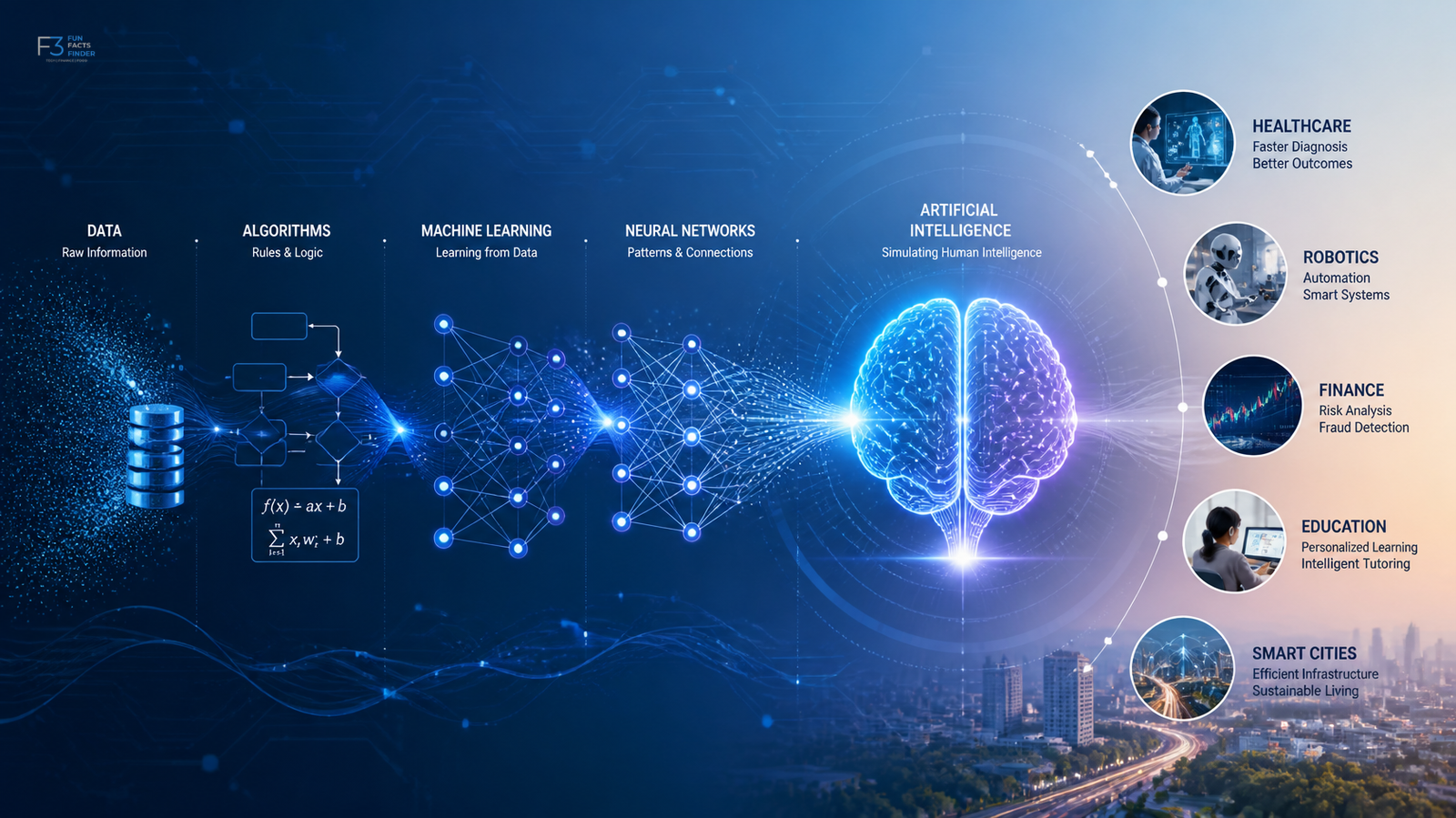
Artificial Intelligence is changing how people work, communicate, learn, shop, and make decisions. From personalised recommendations on shopping websites to virtual assistants that answer complex questions, AI has become an important part of everyday life. But have you ever thought about what actually happens behind the scenes when you ask an AI tool a question or receive an automated suggestion?
Understanding how AI works is no longer limited to software developers or technology professionals. Students, business owners, marketers, and everyday users can benefit from knowing how artificial intelligence processes information, learns from data, and produces results.
Artificial Intelligence (AI) combines data, algorithms, mathematical models, and computing power to perform tasks that traditionally require human intelligence. These tasks include recognising patterns, understanding language, identifying objects, making predictions, and generating new content.
In this guide, we will know how artificial intelligence works, how AI learns from data, the technologies behind it, its real-world applications, and the differences between traditional AI and Generative AI. We will also discuss its benefits, limitations, and future possibilities.
What Is Artificial Intelligence (AI)?
Artificial Intelligence (AI) is a branch of computer science that focuses on developing machines and software capable of performing tasks associated with human intelligence. Is Tho information is enough to know about AI? No! These tasks include learning, problem-solving, decision-making, language understanding, pattern recognition, and information analysis. Unlike traditional computer programs that follow explicitly written instructions, many modern AI systems can learn patterns from data and use those patterns to make predictions or generate outputs.
Let’s explore some instant: – consider an online shopping platform. When you browse products, the platform may analyse your previous searches, purchases, product preferences, and browsing behaviour to recommend relevant products.
This recommendation process can use AI and machine learning models to identify patterns in customer behaviour. According to IBM, modern AI includes technologies such as machine learning and deep learning, which provide the foundation for many intelligent applications.
In simple term, AI helps computers process information, identify patterns, and produce useful results based on the task they are designed to perform.
How AI Works: A Step-by-Step Explanation
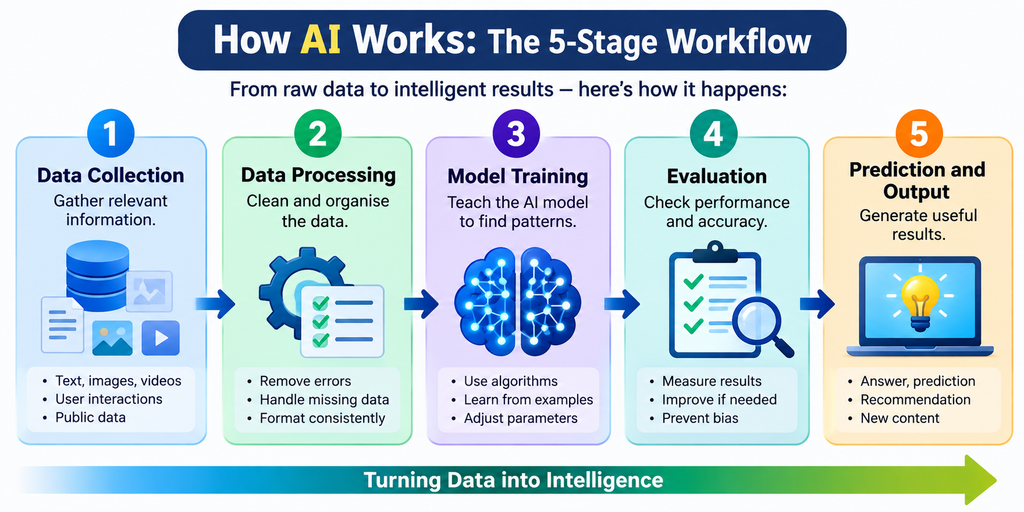
To understand how artificial intelligence works, it is important to look at the complete process, from collecting information to generating a final result. AI systems generally follow a workflow involving data collection, processing, model training, evaluation, and prediction or generation. The exact process varies depending on the AI application.
1. Data Collection
Data is the foundation of most modern AI systems. An AI model needs relevant information to learn patterns and perform its intended task.
Data can come from different sources, including:
- Websites, documents, and digital publications.
- Images, videos, and audio recordings.
- Customer interactions and purchase histories.
- Business databases and transaction records.
- Sensors, machines, and connected devices.
- Public datasets and research materials.
For example, if a company wants to develop an AI system that identifies damaged products, it may collect thousands of product images showing both damaged and undamaged items. The quality, relevance, and representation of the collected data can significantly influence the model’s performance.
2. Data Processing and Preparation
Raw data is not always suitable for direct use in an AI model. It may contain errors, duplicate entries, missing information, irrelevant details, or inconsistent formats. Data processing helps organise information into a usable format.
Common preparation activities include:
- Removing duplicate or irrelevant records.
- Handling missing or incorrect values.
- Standardising data formats.
- Labelling examples where required.
- Converting text, images, or other information into machine-readable representations.
For example, an image recognition model may need thousands of images labelled as cats, dogs, or other objects. Preparing the dataset helps the model learn meaningful relationships instead of relying on inaccurate or inconsistent information.
3. Model Training
Model training is one of the most important stages of AI development. During training, an algorithm analyses examples and adjusts its internal parameters to identify patterns that help it complete a particular task.
For example, a model trained to identify spam emails may analyse thousands of messages containing different words, links, sender details, and formatting patterns.
Over time, it learns which combinations of characteristics are commonly associated with spam. Training does not mean that the AI memorises every example perfectly. The objective is to develop a model that can recognise useful patterns and apply them to new information.
4. Model Testing and Evaluation
After training, developers evaluate how well the model performs on data that was not used during training. This helps determine whether the model can generalise to unfamiliar examples.
Depending on the application, evaluation may measure:
- Accuracy: How often the model produces correct predictions.
- Precision: How many positive predictions are actually correct.
- Recall: How many actual positive cases the model successfully identifies.
- F1-score: A combined measure of precision and recall.
- Response quality: How useful and relevant generated answers are.
For example, an AI-based spam detection system must identify unwanted emails without incorrectly blocking important business communication. Testing helps identify weaknesses and areas that require improvement before deployment.
5. Prediction or Output Generation
Once an AI model is trained and deployed, it can process new inputs and produce outputs.
Depending on its purpose, the output could be:
- A product recommendation.
- A weather or demand forecast.
- An image classification.
- A translated sentence.
- A chatbot response.
- A generated image or video.
- A business performance prediction.
For instance, when a user asks an AI chatbot, “How does machine learning work?”, the system processes the question and generates a response using patterns learned during training and the context available in the conversation.
What Technologies Make Artificial Intelligence Work?
AI is not a single technology. It consists of multiple interconnected technologies that enable computers to process information, learn patterns, and perform different tasks.
The following concepts are particularly important for understanding how AI works.
1. Machine Learning (ML)
Machine Learning is a subset of Artificial Intelligence that allows computer systems to learn patterns from data without requiring developers to manually programme every decision. Instead of providing instructions for every possible situation, developers train a machine learning model using examples.
For example, a bank may use machine learning to identify potentially fraudulent transactions. The system analyses historical transaction data, including spending patterns, transaction locations, amounts, and other relevant characteristics. It then identifies unusual patterns that may indicate fraud.
Machine learning is commonly divided into three learning approaches:
- Supervised learning: The model learns from labelled examples, such as images identified as cats or dogs.
- Unsupervised learning: The model identifies patterns or groups in data without predefined labels.
- Reinforcement learning: The model learns through actions, feedback, and rewards or penalties.
Machine learning powers applications such as recommendation systems, fraud detection, predictive analytics, and demand forecasting.
2. Deep Learning
Deep Learning is a specialised area of Machine Learning that uses multi-layered neural networks to identify complex patterns in large datasets. It is particularly useful when working with complicated information such as images, audio, video, and natural language.
For example, facial recognition software uses deep learning techniques to analyse facial characteristics and identify patterns that help distinguish one face from another. Deep learning is also an important foundation for many modern speech recognition systems, autonomous technologies, and Generative AI applications.
3. Neural Networks
Neural networks are computational models inspired in a simplified way by the structure of the human brain. They contain interconnected processing units called artificial neurons, organised into layers.
A typical neural network contains:
- Input layer: Receives the information.
- Hidden layers: Process information and identify patterns.
- Output layer: Produces the final prediction or classification.
For example, when an image recognition system receives a photograph, its network processes visual features across multiple layers to identify objects or characteristics. The connections between artificial neurons have adjustable numerical values called weights. During training, the model adjusts these weights to improve its performance.
4. Natural Language Processing (NLP)
Natural Language Processing is a field of AI that helps computers understand, process, and generate human language. It enables machines to work with written and spoken communication.
Common NLP applications include:
- Chatbots and virtual assistants.
- Language translation.
- Sentiment analysis.
- Text summarisation.
- Voice recognition.
- Question-answering systems.
For example, when a customer asks a chatbot, “Where is my order?”, an NLP-powered system can interpret the question and identify the information required to provide an appropriate response. NLP plays an important role in conversational AI and many language-based applications.
5. Generative AI
Generative AI is a category of artificial intelligence designed to generate new content based on patterns learned from training data.
It can produce different types of content, including:
- Text and articles.
- Images and illustrations.
- Audio and speech.
- Videos.
- Computer code.
Popular examples include ChatGPT, Google Gemini, and image-generation tools.
For example, a user can provide a prompt such as “Write a professional email explaining a project delay.” A Generative AI tool processes the instruction and produces a relevant draft. Unlike traditional predictive systems that primarily classify information or estimate outcomes, Generative AI creates new outputs.
How Does Generative AI Work?
Generative AI works by learning patterns and relationships from large datasets and using trained models to produce new content in response to user instructions. Many text-generation applications use Large Language Models (LLMs), while image, audio, and video generation can use other specialised or multimodal models.
The process generally involves three important stages.
1. Pre-training
During pre-training, a foundation model learns patterns and relationships from large amounts of training data. For example, a language model learns how words, sentences, grammar, context, and concepts relate to each other.
2. Fine-tuning and alignment
A model may undergo additional training to improve its performance for particular tasks, follow instructions, and produce more useful responses. Different models use different training and alignment techniques.
3. Content generation
When a user enters a prompt, the model processes the available context and generates an output. For a text-based LLM, this generally involves predicting and selecting tokens sequentially. A token may represent a complete word, part of a word, or another text unit. This process allows the model to produce responses, summaries, translations, and other text-based content.
How Do Large Language Models (LLMs) Work?
Large Language Models are AI models trained to process and generate human language. They use deep learning architectures, particularly Transformer-based architectures in many modern systems, to understand relationships between tokens and context.
When a user submits a question to an LLM, the system typically follows these steps:
- Tokenisation: Converts the input into smaller units called tokens.
- Context processing: Processes the input and its surrounding context.
- Pattern analysis: Uses learned representations to determine relationships between tokens.
- Token prediction: Selects likely next tokens based on the context and model configuration.
- Response generation: Repeats the process to generate a complete response.
For example, when you enter “Benefits of artificial intelligence”, an LLM processes the words and generates a relevant explanation based on its training and available context. An important point is that an LLM does not automatically know whether every statement it generates is factually correct. Its output can contain inaccurate or misleading information, which is why important claims should be verified.
AI vs Machine Learning vs Deep Learning: What Is the Difference?
AI, Machine Learning, and Deep Learning are closely related terms, but they do not mean the same thing.
| Technology | Meaning | Example |
|---|---|---|
| Artificial Intelligence | Broad field of intelligent computer systems | Virtual assistants |
| Machine Learning | AI that learns patterns from data | Fraud detection |
| Deep Learning | ML using multi-layer neural networks | Image recognition |
The relationship can be understood as a hierarchy:
- Artificial Intelligence is the broader concept.
- Machine Learning is a subset of AI.
- Deep Learning is a subset of Machine Learning.
In simple terms, all deep learning is machine learning, and machine learning is part of artificial intelligence, but not every AI system uses deep learning.
Traditional AI vs Generative AI
Traditional AI and Generative AI serve different purposes. Traditional AI generally focuses on analysing information, classifying data, recognising patterns, and making predictions. Generative AI focuses on creating new content using patterns learned during training.
| Comparison | Traditional AI | Generative AI |
|---|---|---|
| Main purpose | Analysis and prediction | Content generation |
| Typical output | Classification or prediction | Text, images, audio, video |
| Common applications | Fraud detection, forecasting | ChatGPT, image generation |
| Input | Structured or unstructured data | Prompts and contextual information |
| Example | Predicting customer churn | Writing a customer email |
Both technologies can work together. For example, a business may use traditional machine learning to predict customer churn and Generative AI to create personalised customer retention messages.
Real-World Applications of Artificial Intelligence
AI is already being used across industries to improve efficiency, analyse information, and support decision-making.
Here are some common applications:
- Healthcare: AI can assist with medical image analysis, research, patient administration, and clinical decision support. Its outputs require appropriate professional oversight.
- Banking and Finance: Financial institutions use AI for fraud detection, risk analysis, transaction monitoring, and customer support.
- E-commerce: Online retailers use AI-powered recommendations, product categorisation, demand forecasting, and customer service automation.
- Education: AI tools can support personalised learning, language assistance, educational content development, and student feedback.
- Digital Marketing and SEO: Marketers use AI for keyword research, content analysis, customer segmentation, predictive analytics, campaign optimisation, and understanding search behaviour.
- Manufacturing: AI-powered systems can support quality inspection, predictive maintenance, production planning, and equipment monitoring.
- Transportation: AI helps power route optimisation, traffic prediction, driver assistance, and autonomous vehicle research.
These examples demonstrate that AI is not restricted to one industry. Its applications depend on the data, technology, and problem being addressed.
What Are the Benefits of Artificial Intelligence?
When implemented responsibly, AI can provide several practical benefits.
- Automation: Reduces repetitive manual tasks and supports faster workflows.
- Efficiency: Helps process large volumes of information quickly.
- Data analysis: Identifies patterns that may be difficult to detect manually.
- Personalisation: Supports customised recommendations and customer experiences.
- Decision support: Provides insights that help professionals evaluate different options.
- Scalability: Helps organisations manage growing volumes of data and tasks.
- Innovation: Enables new products, services, and ways of working.
However, these benefits depend on the quality of the system, its implementation, and the suitability of the task.
What Are the Limitations and Risks of AI?
Although artificial intelligence offers significant opportunities, it also has limitations that users and organisations should understand.
- Data quality problems: Inaccurate, incomplete, or unrepresentative training data can lead to unreliable results.
- Bias: AI models can reproduce or amplify unfair patterns present in their training data.
- Hallucinations: Generative AI may produce confident-sounding but incorrect information.
- Privacy concerns: Using sensitive or personal information without appropriate safeguards can create privacy risks.
- Lack of transparency: Some complex models are difficult to interpret, making it challenging to understand why they produced a particular result.
- Human oversight: AI outputs may require review, especially in healthcare, finance, legal, and other high-impact applications.
The National Institute of Standards and Technology (NIST) highlights characteristics of trustworthy AI, including validity, reliability, safety, security, accountability, transparency, explainability, privacy, and fairness. Responsible AI development should consider these factors throughout the system’s design, deployment, and evaluation.
What Is the Future of Artificial Intelligence?
Artificial Intelligence continues to evolve as computing capabilities, datasets, and model architectures improve. Several developments are shaping its future.
- Multimodal AI: Systems that can process combinations of text, images, audio, and video.
- AI agents: Systems designed to perform multi-step tasks using tools and available information.
- Personalised AI: More customised experiences based on user requirements and context.
- AI in business operations: Greater integration with analytics, customer relationship management, and workflow automation.
- Responsible AI: More attention to privacy, security, transparency, and human oversight.
For individuals and organisations, understanding AI fundamentals will become increasingly valuable as intelligent systems become integrated into everyday tools and professional workflows.
Conclusion
Understanding how AI works starts with recognising that artificial intelligence combines data, algorithms, mathematical models, and computing power to perform intelligent tasks.
Technologies such as Machine Learning, Deep Learning, Neural Networks, NLP, and Generative AI contribute to different AI capabilities. Together, they support applications ranging from fraud detection and product recommendations to conversational assistants and content generation.
However, AI is not a replacement for human judgement. Its effectiveness depends on the quality of data, model design, evaluation, and responsible implementation.
Whether you are a student exploring technology, a professional developing new skills, or a business owner considering automation, learning how artificial intelligence works can help you make more informed decisions about its opportunities and limitations.
Frequently Asked Questions About How AI Works
1. How does AI work in simple terms?
AI works by processing information, identifying patterns, and using trained models to produce predictions, recommendations, or generated content. It uses algorithms and data to perform tasks that traditionally require human intelligence.
2. How does artificial intelligence learn?
Artificial intelligence learns through training processes in which algorithms analyse examples and adjust model parameters to identify patterns. The trained model can then apply those patterns to new information.
3. Does AI think like a human?
No. AI systems process information using mathematical models and computational techniques. Although some systems can perform tasks that appear intelligent, their operation is fundamentally different from human consciousness and understanding.
4. What is the difference between AI and Machine Learning?
Artificial Intelligence is the broader field of creating intelligent computer systems. Machine Learning is a subset of AI that enables systems to learn patterns from data rather than relying entirely on manually programmed rules.
5. What is the difference between Machine Learning and Deep Learning?
Machine Learning includes techniques that help computers learn from data. Deep Learning is a specialised subset that uses multi-layered neural networks to learn complex patterns.
6. How does ChatGPT work?
ChatGPT uses large language models to process prompts, understand conversational context, and generate responses. The model processes tokens and predicts subsequent tokens to create a response.
7. Can AI work without the internet?
Yes. Some AI models can run locally on computers or other devices without an active internet connection. However, other AI applications depend on cloud infrastructure, external databases, or online services.


